
What Do You Need to Know to Use Lasers in a Live Show or Event in the US?
To use lasers in a live event in the United States, you need three things: an FDA-accepted laser bought from a US vendor, a laser variance from the FDA, and a safe setup with emergency stops, beam blocks, and the required clearances above and beside your audience. Add a control method that fits your team, and a daily safety checklist.
Lasers can seem mysterious, but they don't have to be. They're more capable and more approachable for live events than they have ever been. Here's how to get started the right way.
Key Takeaways
A laser variance is your registration with the FDA to produce laser shows, and it must be renewed every year.
Buy lasers from a US vendor. A laser that isn't FDA-approved for US use is not legal here, even if it has an emergency stop.
Beams must stay at least 3 meters (about 10 feet) above anywhere audience members can stand, and 2.5 meters (about 8 feet) away horizontally.
You can control lasers with computer software, a simple app, or full DMX. Each has trade-offs.
Follow your manufacturer's daily safety checklist, every day.
What Is a Laser Variance and Why Do I Need One?
A laser variance is permission from the FDA to produce laser light shows. Think of it like a driver's license: it registers you with the government as someone who can create laser shows.
Why the FDA? When people are injured by lasers, it falls under the FDA's jurisdiction because the harm is to the human body. Under the FDA's rules, laser demonstrations, displays or shows using lasers above 5 milliwatts need a variance, and the application includes a show report describing how you plan to use the laser and what safety measures you'll take.
The paperwork can be confusing, because it was never designed with entertainment in mind. It was written with uses like construction or medical work in mind. The good news is that the major laser manufacturers have processes and simple sets of forms to walk you through it when you buy from them.
How Long Does It Take to Get a Laser Variance?
Leave time. Don't order a laser and assume your variance will arrive before the laser does. It sometimes takes a few weeks or longer.
Variances also expire every year. Put a reminder on your calendar, watch your email, and go through the same process with your manufacturer each year to renew. In my experience, the renewal window falls in late summer, before September 1. (Check the exact timing with your manufacturer.)
Why Should I Buy Lasers From a US Vendor?
Because a laser has to be legal for use in the US, and a lower price from overseas often isn't worth the risk. We've seen many customers say, "I can get this laser internationally for half the cost." If it isn't approved by the FDA for use in the United States, it isn't legal. Period.
This matters most if you're going through the steps to get a variance. You need a laser that is safe and verified for US use.
An emergency stop alone doesn't make a laser compliant. Plenty of lasers made overseas have one and still fall short of US rules for other reasons. Compliance also covers how the laser works, how it scans, and how it responds, all required together. A variance, an emergency stop, and a compliant laser: you need all of them.
Do I Need Insurance to Run Lasers?
Yes. Your company, or whoever you're working for, should carry reasonable liability insurance that covers laser use. We can't advise on insurance here at Above AVL, so talk it through with your insurance provider.
The reassuring part is that entertainment laser injuries are very rare, in the US and around the world. In most cases, adding lasers won't send your rates through the roof.
How Do I Control Lasers in a Live Show?
There are three main types of laser control. Which is right depends on your show, your team, and your budget.
Computer-Based Control
This is the most common approach. Software such as Pangolin QuickShow or Beyond connects to your lasers, usually over Ethernet, or through FB3 or FB4 devices and ILDA cables. You build shapes, patterns, and animations, place them on a timeline, and (with the right license level) trigger them by DMX or timecode.
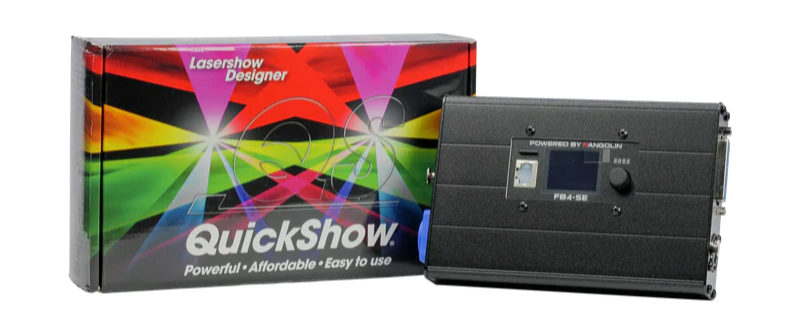
The downside: you always have a computer running, and smooth crossfades between looks usually aren't possible. You typically fade the laser out, switch the animation, and fade back up. It's still a great choice for graphics and for animations projected onto a surface, not just beams in the air.
App-Based Control
Some lasers use a simple app. LaserCube products, distributed in the US by X-Laser, are network-based and can be controlled from a PC, phone, or tablet. They have plenty of animations, are about the easiest lasers to control, and generally have standalone modes. The trade-off is that a proprietary app limits how much control you get.
Full DMX Control
You can upload patterns from QuickShow or Beyond to your laser and trigger them by DMX, but the crossfade limitation remains.
This is where X-Laser’s Mercury software shines. Mercury is built 100% into the laser. You send it DMX, directly or over a network-based DMX protocol, and control the laser just like a moving light from your lighting console.
That means you can fade between media or animations, and change color on the fly, perfectly in sync with the rest of your lighting. We find Mercury gives the most natural, seamless laser looks. It isn't right for every application, so talk with our team about which method fits you.
What Does the Physical Laser Setup Look Like?
Lasers are controlled from a lighting console or control software, usually over Ethernet and sometimes over DMX. The key safety pieces are emergency stops and beam blocks.
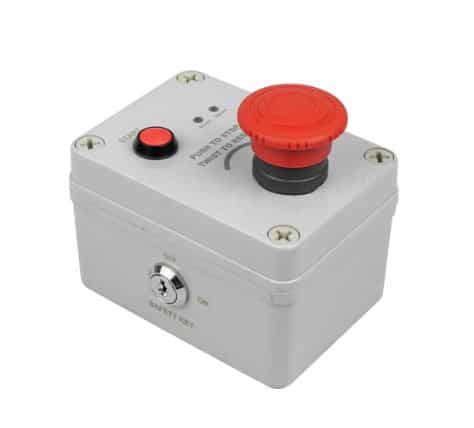
Emergency stops. E-stops must be run by the laser operator and/or other people who have a clear view of the entire beam and where it terminates. You can, and often do, have several in one setup. How they connect depends on the laser. With most Pangolin or Unity lasers, the e-stop uses microphone cable and can be chained, as can multiple projectors. With X-Laser e-stops, the e-stop becomes part of your control network, so one Ethernet cable carries e-stop data and DMX to the lasers.
Beam blocks. Install physical beam blocks anytime you set up a laser, to keep the beam out of areas it isn't intended to reach.
What Are the Laser Safety Distances for Audiences?
Beams must stay at least 3 meters (about 10 feet) above any surface audience members can stand on, and at least 2.5 meters (about 8 feet) away horizontally from anywhere the audience can access. Under condition 13(a) of the variance application, beams must be kept at least 2.5 meters laterally and 3.0 meters vertically from audience access. The FDA's own variance form also states that laser radiation above Class I limits is not permitted less than 3.0 meters above any surface where persons other than the show crew can stand.
Trained performers and staff can be closer, as long as you brief them on where the laser will be and how to be safe around it.
Lasers must also always terminate. Outdoors, that means hitting a surface rather than firing into the sky. If a beam goes into the sky, you need FAA permission and someone monitoring it at all times. The variance process also requires a Notice of Proposed Outdoor Laser Operations filed with the FAA.
Every manufacturer offers good safety courses. Take them before you use the laser.
What Should I Do Every Day I Run Lasers?
Follow your manufacturer's daily checklist. It confirms you're compliant and safe each day, and it's not optional.
When you've done your homework up front, lasers are a lot of fun, and a single laser can replace several moving lights in your rig.
FAQ
Can I legally buy a laser from an overseas vendor to save money? Only if it is approved by the FDA for use in the United States. If it isn't, it isn't legal here, even if it costs half as much.
Do I need a variance for a small laser? The FDA requires a variance for laser shows and displays using lasers above 5 milliwatts, according to this summary of US laser law. Confirm your situation with your manufacturer.
Can I fire a laser into the sky at an outdoor event? Not without FAA permission, and someone must monitor the beam at all times. Otherwise, the beam must hit a surface.
Does an emergency stop make a laser legal? No. An e-stop is required, but compliance also depends on how the laser works, scans, and responds.
Will lasers raise my insurance rates? In most cases, not significantly, because entertainment laser injuries are very rare. Talk to your insurer.
Get Your Lasers at Above AVL
If this was helpful, Above AVL is the place to get your lasers. We carry multiple brands and types, and we can help you find the best fit and get it into your hands at your personalized price.
Contact us and we'll help you figure out the quantity, size, and brightness that's right for your needs.
